
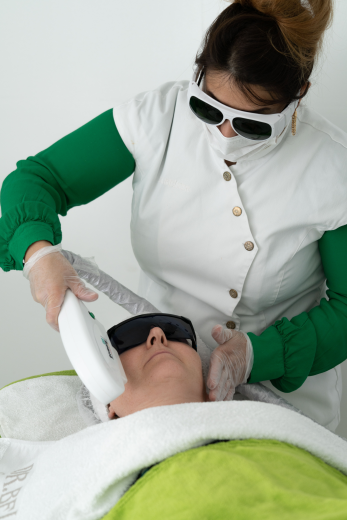
Facial laser hair removal is designed to achieve long-term reduction of unwanted hair on the upper lip, chin, and other suitable areas of the face. Treatments are tailored to individual needs based on hair thickness, skin type, and hormonal factors.
Facial laser hair removal is a treatment designed to achieve long-term reduction of unwanted hair on the upper lip, chin, and other suitable areas of the face.
Laser energy is absorbed by melanin, the pigment found in hair, and converted into heat. This heat affects the structures responsible for hair regrowth, helping to gradually reduce hair density over time.
Facial hair has different characteristics compared to hair on other parts of the body. Particularly in women, hormonal changes, hair thickness, and the natural hair growth cycle can influence treatment outcomes.
How Is Facial Laser Hair Removal Performed?
Before treatment, skin type, hair color, hair thickness, and hair distribution are assessed.
Dark, coarse hair generally responds better to laser hair removal, while treatment may be less effective on fine or light-colored facial hair.
For this reason, not all facial hair is suitable for laser treatment.
For eligible individuals, the appropriate laser system and treatment settings are selected, and a session plan is developed.
Which Areas of the Face Can Be Treated?
-
Upper lip
-
Chin
-
Under the chin
-
Sideburns
-
Other suitable facial areas
Eye safety is particularly important during facial laser hair removal. Laser treatment should not be performed directly on high-risk areas such as the eyelids or around the eyebrows.
Why Is Facial Hair Growth Important in Women?
Coarse hair growth on the chin and upper lip in women may sometimes be associated with hormonal factors.
Polycystic ovary syndrome (PCOS) and changes in androgen levels are among the possible causes of unwanted facial hair growth.
If facial hair growth develops suddenly, increases rapidly, or occurs alongside symptoms such as irregular menstrual periods, a medical evaluation may be necessary before treatment.
Can Fine Facial Hair Be Treated with Laser Hair Removal?
Fine, light-colored facial hair may not absorb enough laser energy for effective treatment.
In some individuals, laser treatment may also cause existing fine hairs to become thicker or increase hair growth, particularly on the face and neck. This phenomenon is known as paradoxical hypertrichosis.
For this reason, laser hair removal is not always an appropriate choice for fine facial hair.
How Should You Prepare for Facial Laser Hair Removal?
-
Avoid excessive sun exposure and tanning beds before treatment.
-
Stop waxing, tweezing, threading, and other methods that remove hair from the root for the recommended period before your appointment.
-
Make sure the skin is clean before treatment.
-
Inform your practitioner about any medications you are taking and existing skin conditions.
-
Disclose any history of cold sores or active skin infections so that suitability can be assessed before treatment.
What Should You Avoid After Facial Laser Hair Removal?
Temporary redness, mild swelling, and skin sensitivity may occur after treatment.
During the first 24–48 hours, it is generally recommended to avoid hot water, saunas, intense exercise, and potentially irritating cosmetic products.
Because the face is regularly exposed to sunlight, consistent sun protection is especially important.
How Many Facial Laser Hair Removal Sessions Are Needed?
The number of sessions varies depending on hair thickness, hair color, hormonal factors, and individual response to laser treatment.
Due to hormonal influences on facial hair growth, some individuals may require additional sessions or maintenance treatments over time.
Facial Laser Hair Removal at Armin Pure Beauty
At Armin Pure Beauty, facial laser hair removal treatments are planned within the beauty and skin care studio managed by Şebnem Müştak, taking individual skin and hair characteristics into consideration.
Special attention is given to assessing treatment suitability in individuals with fine facial hair, suspected hormonal hair growth, or sensitive skin.
Our goal is to support long-term reduction of unwanted facial hair in suitable candidates while prioritizing skin health and treatment safety.
Facial laser hair removal is not suitable for every hair type. Results may vary from person to person. A dermatological evaluation may be necessary in cases of hormonally influenced hair growth, active skin conditions, or other circumstances requiring additional medical assessment.
Frequently Asked Questions
01 Can Laser Hair Removal Be Used on All Types of Facial Hair?
No. Dark, coarse hairs are generally better targets for laser hair removal. Fine, peach-fuzz-like facial hair may respond poorly, while white, gray, and very light-colored hairs are unlikely to respond effectively. Rather than treating the entire face in the same way, each area and its hair characteristics should be assessed individually. Source: American Academy of Dermatology
02 Can Facial Laser Hair Removal Increase Hair Growth in Some People?
Yes. In some individuals, hair may become thicker, more noticeable, or more abundant in or around the treated areas. This phenomenon, known as paradoxical hypertrichosis, is particularly important to consider when treating the face and neck. A careful assessment of skin and hair characteristics is essential before treatment. If increased hair growth occurs, medical evaluation is recommended rather than continuing the same treatment approach without reassessment. Source: Endocrine Society
03 Are Hormone Tests Necessary for Unwanted Chin or Upper Lip Hair?
Hormone testing is not necessary for every case of localized facial hair growth. However, in women, rapidly increasing facial hair, irregular menstrual periods, significant acne, or scalp hair thinning may indicate a need for hormonal evaluation. Laser hair removal targets existing unwanted hair but does not treat underlying hormonal conditions. A physician should determine whether laboratory testing is necessary. Source: Endocrine Society
04 Can Facial Laser Hair Removal Remove All Hair Permanently, and How Many Sessions Are Needed?
Facial laser hair removal can provide long-term hair reduction, but complete, lifelong hair removal cannot be guaranteed. Hormonal influences, particularly in women, may contribute to new hair growth over time, making maintenance sessions necessary. The number of sessions and treatment intervals depends on hair characteristics, the treatment area, and individual response. There is no single treatment schedule suitable for everyone. Source: American Academy of Dermatology